 Brixel Proyect
Start with proof you can verify
The first trust signal on a contractor site should be simple proof that you are allowed to do the work. Show your license information where visitors can find it without hunting. If you carry insurance, say so in plain language. Homeowners do not want legal talk. They want to know you are a real business and that you take the work seriously.
Put this proof near the top of your site and again on your contact page or service pages. Do not bury it in a long paragraph. Use short labels like licensed, insured, and locally based if they are true. If you serve more than one area, say that clearly too. A visitor should not have to guess where you work or what kind of jobs you take.
- Use the exact business name that matches your paperwork.
- If a license number is public, place it where people can check it.
- If something is not true, leave it out.
Use real reviews, not copied praise
Reviews matter because they sound like other customers talking to the next customer. But only if they feel real. Short, specific reviews are better than a wall of vague praise. A line like "fixed the leak the same day and explained the problem clearly" helps more than "great company" because it shows a real job and a real outcome.
Do not write fake reviews yourself or ask friends to invent them. People can usually feel when praise is too polished. If you have reviews from Google or Facebook, show a few that mention the type of work you do, your communication, or how clean the job site was left. If a review mentions the owner by name, that can help too, since it adds a human face to the business.
- Choose reviews that mention real services, not just kind words.
- Keep the wording exactly as the customer wrote it.
- If a review includes a city or neighborhood, that can help local trust.
Let people see the actual crew and job sites
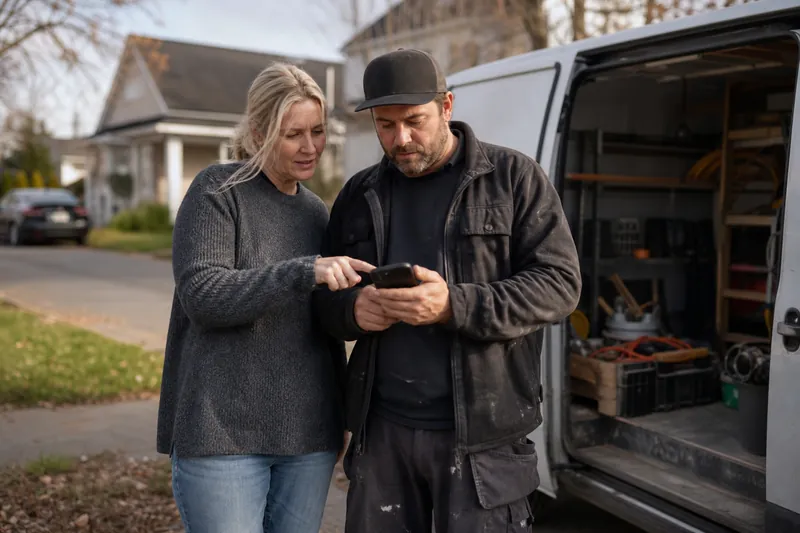
Real photos do more for trust than polished stock images. A homeowner wants to see what your team looks like, what your truck or van looks like, and what your work looks like on an ordinary day. Stock photos often feel too perfect. They can make a local business seem distant or fake.
Use candid photos from real jobs when you can. Show the owner, the crew, and the kind of spaces you work in. A smiling team in front of a finished job is fine, but a photo of a worker measuring, repairing, cleaning up, or walking a customer through the work can feel even more believable. Make sure the photos are clear and current. If the people in the photo are no longer on your team, replace it.
- Take photos in daylight when possible.
- Show clean work areas, not just finished rooms.
- Avoid images that look like they came from a stock library.
Put the owner or lead tech on the page
People hire people. A contractor website feels more trustworthy when a real owner or lead tech is visible and named. A face, a short intro, and a clear role help visitors feel that there is a real person standing behind the business. This does not need to be a long story. A simple photo and a few honest lines are enough.
Try to show what the owner cares about: careful work, clear communication, showing up when promised, or keeping the job site clean. That kind of detail sounds human because it is human. If the owner is not the one who goes on every job, say who does. The goal is not to impress people. The goal is to reduce doubt.
- Use the same name that customers hear when they call.
- Choose a friendly, well-lit headshot or a natural work photo.
- Write like a person, not like a brochure.
Make local details easy to find
Local service businesses win trust when visitors can tell they are nearby and can reach the right service area. Put your city, nearby neighborhoods, or service area on the site in a clear spot. If you have a public address, show it. If you work from a home office or do not want the full address on the site, list the areas you serve and make that clear instead.
Do not make people dig for this information. A footer, contact page, and service area page are all useful places for it. If you have a Google Business Profile, keep the business name, address, and phone details consistent with what is on your website. Small mismatches can make a site feel off, even if the business is real.
- Use the same city and business name everywhere.
- List the neighborhoods or towns you actually serve.
- If you change locations, update the website right away.
Watch out for fake signals that can hurt you
Some websites try too hard to look trustworthy and end up looking fake. Overused stock photos are one of the biggest problems. So are badges you cannot explain, partner logos you do not really have permission to use, and claims that sound bigger than your business really is. Visitors notice when things feel borrowed.
Another weak signal is the too-perfect website. If every photo is staged, every review sounds written by the same person, and every line says the business is the best at everything, people may back away. Real trust comes from plain proof, not big claims. It is better to sound like a careful local business than like a sales page trying to push too hard.
Also watch for old details. An outdated team photo, a closed office address, a broken review widget, or a service list that includes work you do not offer can all make people hesitate. The fastest way to lose trust is to look forgotten.
- Remove any badge or logo you cannot explain.
- Replace old team photos when the crew changes.
- Keep the services listed on the site true to what you do now.
Questions owners ask
Do I need to show my license number on the website?
If your license is public and relevant to your trade, showing it can help people feel safer reaching out. Keep it easy to find, but do not hide it in tiny text. If you are not sure what should be public, check your local rules before posting it.
Are testimonials better than reviews from Google?
Both can help, but Google reviews often feel more believable because they come from a third-party profile. A short testimonial on your site can still work well if it names the service, the customer’s city, or a specific job. The best mix is a few site testimonials plus live reviews from Google or Facebook.
What if I do not have many photos yet?
Start with the photos you can take this week: the owner, the crew, the truck, tools in use, and a few clean job-site shots. You do not need a giant gallery to look real. A small set of honest photos is better than a page full of stock images.